

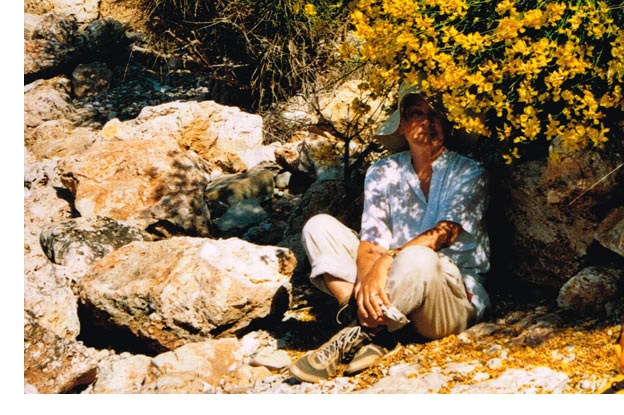
ERIKA MARIJA KURELAC created her final painting phase with landscape themes exclusively in the innovative, unorthodox, and demanding watercolor technique on canvas. Her creativity was always inseparably connected to her love of nature, her research trips related to art history, and her consequent painting en plain air.
Mastering the watercolor technique, with which she was occupied from the very beginning, enabled the desired application of randomly thick pigments on dry or wet paper support, achieving the typical effect of translucent glaze, which she successfully transmitted to the canvas, including characteristic dripping and paint bleeding.
She simultaneously experimented with variously structured, mostly handcrafted papers made from various materials as well as countless pigments and fixatives.
Building on this considerable experience, the artist tackled the demanding process of watercolors on canvas, which clearly belongs to the most complex painting techniques, leaving no room for subsequent interventions or corrections.
This may also be one of the main reasons why visual artists tend to avoid this technique, being a rarity both on the European and global visual arts scene.
Through her most popular visual motifs, such as landscapes, cityscapes, and floral still lifes created at each of her visits to a natural environment, the artist conveyed to the observers her meditative observations and spiritual perceptions of nature as a visual narration, while her painting works resemble diary notes, revealing the artist's almost sacred attitude towards the chosen subject.
A diversity of visually expressive approaches, reaching from realistic, nature-imitating vistas, through expressive deformations and depictions of signs and symbols, to fast-paced impressions, often on the brink of abstraction, can be observed throughout the artist's body of works.
Older works by Erika Marija Kurelac still display a concurrence of drawing and painting morphology, e.g. a duality that suits the artist's aspiration to a balanced emotional and rational perception of reality in art, pursuant to the theory of Heinrich Wölfflin. However, her later opus reveals a distinct transition to pure vividness, which indeed most closely corresponds to the essence of watercolor technique as well as the artist's increasingly meditative perception of nature.
At the same time the abstraction progresses, wherein sky and water are blending into each other such that the line between them can no longer be determined, having also a symbolic, one might even say, a sacred meaning (... sicut in caelo et in terra).
Like many European and world artists, starting with French impressionists, who have been inspired by the Côte d'Azur, so many South Slavic artists were captivated by Dalmatia, last but not least similarly Erika Marija Kurelac took a special interest in the romantic hamlet of Bol on the southern coast of Brač Island.
The glowing light of the Adriatic, next to the intense experience of unspoilt nature unobtrusively supplemented with historical architecture monuments, many years ago inspired the artist to capture visual impressions, including the intimate experience of nature.
Despite the omnipresent feeling that time has truly stopped in these places, the spirit of the ambience actually changes with every moment, as is evident not only in the watercolors but also the acrylics and the pastels depicted by the artist.
The painter namely preserved the impressions of both weather and light changes, as well as of the changing seasons, since she was present in these places in every period of the year and at all weather conditions. Hence, the visual whole often conveys an effect of vibrating or trembling atmosphere, typical for climate turbulences.
Erika Marija Kurelac was an artist who knew how to completely harmonize both with nature and her artworks, by reaching into the transcendental dimensions of life, as if it were an artistic worship of Creation.
Mario Berdič, art critic and curator, Maribor, Slovenia