

13 September 1941 - 19 April 2014
Erika Marija Kurelac (née Brečko), daughter of a dressmaker and a baker, was born on 13 September 1941 in Radvanje near Maribor (Slovenia). At the end of World War II, in 1945, she moved with her family to Šentjur near Celje, a small village, where she grew up with her two younger brothers in the midst of the unspoilt nature and forests. After concluding primary school, she continued her education at the grammar school in Celje and after that at the school of nursing. She graduated in 1962 and worked at the Department of Neuropsychiatry at Maribor hospital for the next 11 years.
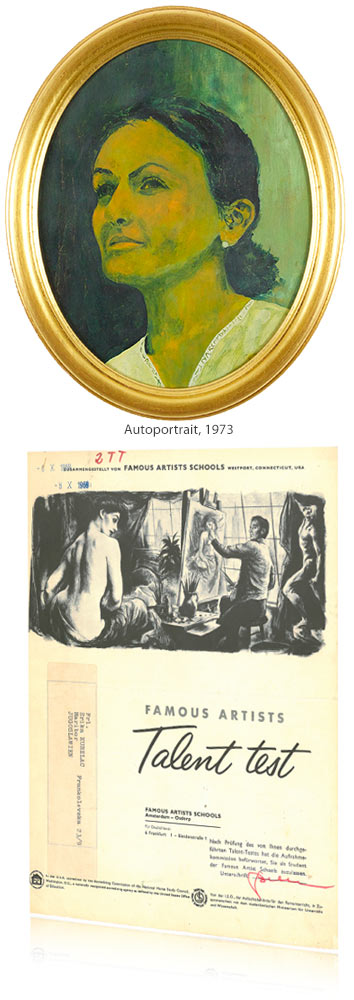
Her talent for painting had already been revealed during her teenage years, mostly in pencil drawings. Her inner longing and overwhelming need to create never faded. Thus she passed a talent test at the Munich correspondence department of the Famous Artists School Westport in Connecticut, where she enrolled in the study of illustiration and graphic arts. Her graduation in 1971 finally confirmed her mission of being an artist. As a lone parent of an eight-year-old daughter from her marriage with Dr Zlatko Kurelac, an ophthalmologist, she left her job as a nurse and began to study fine arts at the Maribor Faculty of Education. After her graduation in 1974 and right up to her retirement she worked as an art teacher at a primary school for children with special needs. Helping these children to develop their artistic expression and working ability particularly reflected her exceptional teaching talent. As a meritorious art pedagogue she thus received numerous domestic and international awards. For over a decade she mentored art colonies for children with intellectual disabilities who participated with their artworks in several exhibitions and competitions. She ran an art workshop for pre−school children at the Maribor Adult Education Centre and in 1984, she published a compendium entitled Contributions to Art Classes for Pre-school Children. She also passed on her knowledge of art history to grammar school students. Besides all this, she illustrated a poetry collection and designed the cover of a novel. Medical education and her work in neuropsychiatry raised an interest for an in-depth study of behavioral therapy, in which she obtained an internationally recognized certificate. Despite her pedagogical work, the care of her only daughter Seta, and later also her grandson Aljoša, to whom she was especially attached, she always found time for her painting.
After retirement, she completely dedicated herself to the creation of fine art. The Dominican Monastery in Bol on the Dalmatian Island of Brač (Croatia), where all her life she spent her holidays, since retirement had become her second home. The contemplative spirit of this medieval monastery with its wonderful garden with a vista of Hvar Island, the Mediterranean atmosphere, and the whole environment reflecting spring, summer, or autumn shades of colour always provided her creative energy with additional inspiration. The paintings she left behind, perpetually mirror the irrevocable moments of her fusion with nature.
Erika Marija Kurelac created numerous works in various techniques that have been displayed in many group and solo exhibitions. Her opus of watercolors on canvas, being a rare and specific feature on the European and global art scene, was presented at the exhibition Meditation of Nature at the Maribor Synagogue Cultural Center in April 2008.
Svjetlana (Seta) Kurelac, art historian and conservator of cultural heritage
Maribor (Slovenia) on Google Maps
Bol on the Dalmatian Island of Brač (Croatia) on Google Maps
Discovering Maribor on YouTube
Maribor, Slovenia - Travel Around The World on YouTube
Maribor from Above on YouTube
Island of Brač (Croatia) on YouTube
2CELLOS - Chariots of Fire on YouTube (filmed on the island of Brač)
Življenje je vse obsegajoče in vse prežemajoče, ter naše osebnosti presegajoče.
A ker se ljudje vse preveč zapletamo v razsojanje, kaj naj bi bilo prav in kaj ne,
namesto svetlobe na koncu življenja navadno vidimo le obrise teme.Življenje samo, pa je brezčasno, neskončno in neuničljivo
in v prihajanju in odhajanju se nam zrcali bistvo njegovo,
ki je misterijozno in neizrekljivo.In prav v tem Bistvu se kaže naša prava narava, ki nam je izkustveno dosegljiva le, ko potihne umska zmešnjava.
A žal za večino smrt, je navadno edini tak pripetljaj, ko potihne vsa umska zmešnjava in nenadno odpro, se nam Vrata v Raj.
Life is transcending our personalities,it is all prevalent and omnipresent.
But on account of mankind's judgmental wise of life, people at the end of their life instead of light, usually see only contour of the darkness.
The life itself but is boundless, unframed and in our coming and going reflects its essence that is mysterious and indescribable.
Exactly in this essence is seen our true nature, that we can experience only when the intellectual confusion becomes silent.
But unfortunately for the majority, only such occasion is our death in which the gates of the eternity suddenly open up.
* Translated by Urška Lindič